
Written by Maggie Ho · Originally published by Fête Chinoise
Images Courtesy: Stratford Festival, Photography by David Hou
First published in English in the 2026 Fête Chinoise Design Annual (read here), and in Chinese on The Culturist 文化者 (read here).
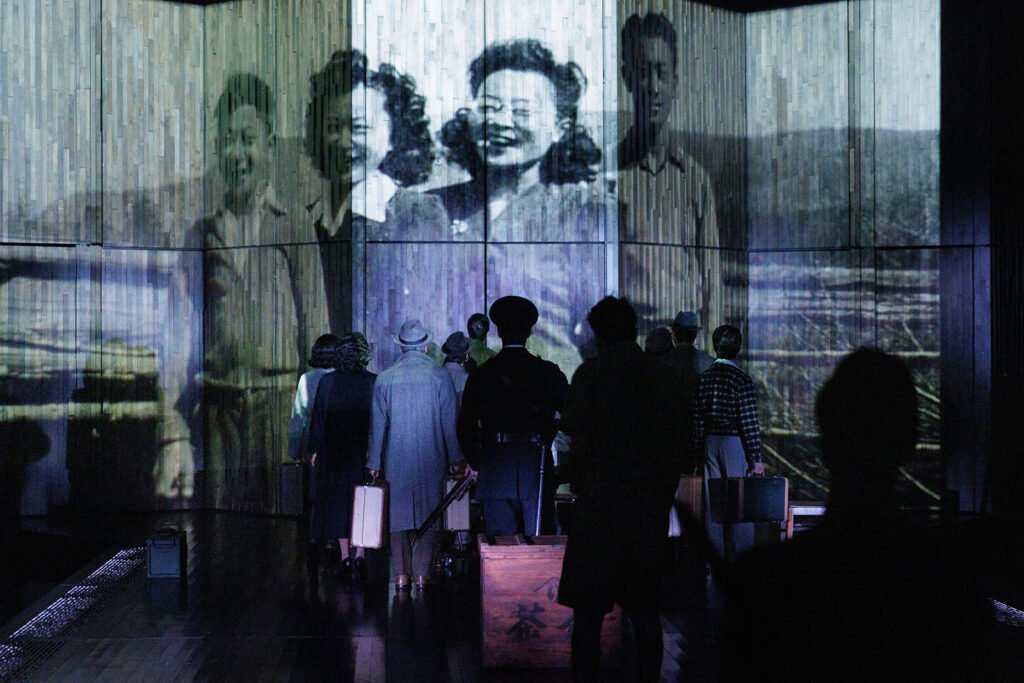
From the moment the audience steps into the Tom Patterson Theatre, they are immersed in an atmosphere thick with memory and history. The two leading actors move solemnly along a runway-like stage, drawing the audience’s gaze to a few simple yet carefully chosen props. Even before the performance begins, the stage design has already captured everyone’s attention.
What follows is nearly three hours of tightly woven storytelling that spans three generations and crosses the Pacific. The play traces the intertwined fates of two families across Canada, Hong Kong, and Japan, framed by the upheavals of the Second World War.
Based on Mark Sakamoto’s acclaimed memoir and written by playwright Hiro Kanagawa, Forgiveness reveals the intimate lives of Mitsue Sakamoto—a Canadian-born Japanese whose youth is shattered by internment camps—and Ralph MacLean, a young soldier sent to defend Hong Kong who is later captured in a Japanese POW camp. Their stories, both epic and personal, converge decades later when their children fall in love. The question lingers: after all these years, how do you stand before someone who reminds you of those who once broke you?
The production makes excellent use of the signature elongated thrust stage, bringing memory to life and revealing multiple perspectives side by side. Past and present, tragedy and resilience, war and home are interwoven. Forgiveness shows that reconciliation is never simply a matter of two opposing sides. On one hand, Japanese soldiers brutalize Canadian prisoners of war; on the other, Japanese Canadians in British Columbia endure unjust persecution by their own government. This mirrored storytelling underscores the complexity of history and the shared humanity within it.
The performance is exceptional. Jeff Lillico, as Ralph MacLean, brings to life a vivid transformation: from a naive country youth to a soldier scarred by captivity, and finally to a father who rediscovers joy and compassion through his daughter. Yoshie Bancroft, as Mitsue Sakamoto, moves from an innocent, dreamy teenage girl to a woman hardened by the suffering and anger of internment, ultimately becoming a strong mother who chooses to forgive yet never forgets. She embodies a mix of Scarlett O’Hara’s resilience and the poised, enduring strength of a Yamato Nadeshiko, the ideal of traditional Japanese femininity.
To tell a story that spans time and geography, most of the cast assume multiple roles. Hiro Kanagawa portrays both Mitsue’s loving, hardworking father and a Japanese commandant who must fulfill his duty while quietly doubting its morality. Steve Hao transitions seamlessly from a bullied Chinese immigrant laundryman to a ruthless Japanese soldier, and finally to a heartbroken Japanese Canadian whose home and dreams are destroyed. This multi-role casting is a highly effective artistic choice, highlighting the actors’ range while deepening the audience’s engagement.
Visually, the production is both intimate and striking. Projections, lighting, and sound transform the space effortlessly into a dining room, farmland, battlefield, or prison cell. Minimal props spark the imagination: a warm wooden dining table and rice box evoke the essence of a Japanese household, while a simple fishing net, paired with light and sound, conjures the family’s fisherman heritage during Mitsue’s father’s passing. Each scene flows seamlessly, with minimal props yet a visual richness that invites the audience to imagine the world fully.
At its core, Forgiveness is a thoughtful, reflective piece, especially relevant today when politics and misunderstandings can so easily fuel prejudice and division. The play reminds us that grace, not resentment, allows us to move forward. Masterfully crafted, and impeccably performed, it leaves the audience with something deeply profound to carry home.
加拿大Stratford Festival 2024/25季度劇作《推銷員在中國》於8月23日全球首演。該劇是劇團自1952年創立以來,首次委約創作的英語、國語雙語演出劇目,從劇本、演出、以至製作及宣傳,均屬劃時代用心之作。
《推銷員在中國》劇本由施崇梵 (Jovanni Sy) 與 Leanna Broodie共同創作,講述美國劇作家亞瑟‧米勒 (Arthur Miller) 於1983年到訪北京,親自執導北京人民藝術學院演出其名作《推銷員之死》(Death of a Salesman)的中文版演出。一個來自美國的「老外」導演,遇上了經歷過上山下鄉運動的中國戲劇大師英若誠,二人合力在改革開放中的新中國進行一次「洋戲土演」歷史性演出。
同樣是外藉人士在中國感受文化沖擊的題材,《推銷員在中國》比美國華人劇作家黃哲倫的得獎作品《中式英語》(Chinglish)更具層次、更全面審視東西兩方不同的生活、文化及思想 。其中最意味深長的一幕,亞瑟‧米勒對於北京人藝「戴假髮假鼻演洋戲」的手法感到荒謬胡鬧,英若誠理解米勒的憤怒,但作為一個協調者、一個製作人、一個亞洲人,他背負着各式人事習俗等考慮,最後吐出的一句「那就是我們(中國人)學習(西方)戲劇的方法。」說出了固中的無奈與現實。
劇內處處充滿了火花四起且又庸智非凡的對話,更難得的是對白因應角色的設定夾雜英語與國語,兩種語言的對白與字幕同樣精警傳神。是編劇的智慧、亦是翻譯的功力;是演員的精湛演譯,亦是字幕人員的精準控制,劇團上下每個岡位成就了一場又一場節奏起伏,精采得不得了的一齣好戲。
劇場是現實與夢想的投射。不論是《推銷員之死》中1949戰後的美國、1983年解放後的北京、抑或是當下2024年《推銷員在中國》演出的加拿大,不同年代,不同地域文化,戲裏戲外都在面對新舊交替、經濟社會形勢急遽改變及大量外來文化湧現的問題。身處其中,該如何自處?編劇與導演施崇梵用創作作出回應,蘊釀六年,《推銷員在中國》台前幕後用行動證明擁抱不同文化,共同努力搭建一個不同文化的每一位都同樣能發光發熱,一同感受彼此的作品。台上少見的由多數華裔演員擔起一整台戲,台下不同文化背景的觀眾共聚一堂,各自在劇內找到反思與慰寂。如此大同感人場面,為一眾追求多元大同而努力的人士帶來盼望。