
Article by: Maggie Ho
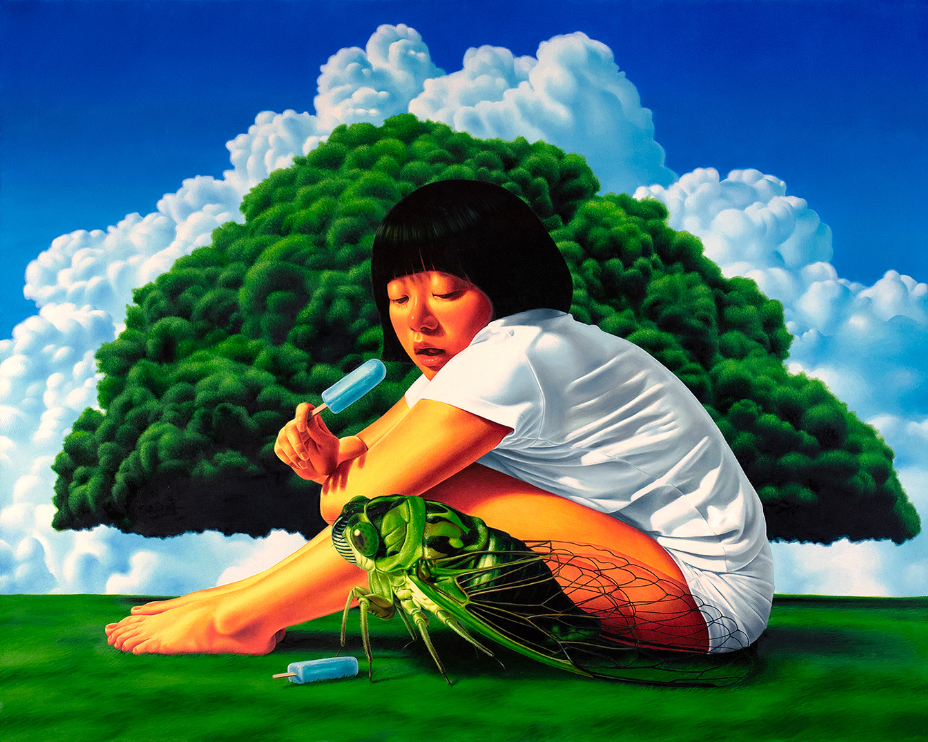
Artwork: Hayley Chi Hay Chiu, What does the cicada know of ice?, 2026, oil on canvas. Courtesy of the artist and Varley Art Gallery.
First published in the 2026 Fête Chinoise Design Annual. Read the full edition here.
A chubby, bob haircut, round-faced girl sits alone in a quiet room. The space is saturated with colour: Lucky Cats, glowing red lanterns, mahjong tiles, and kai ko goldfish drifting through the air like fragments of memory. It’s a crowded, theatrical universe hovering between dream and lived experience. This is the signature visual world of emerging Canadian artist Hayley Chiu. At first glance, her drawings radiate exuberance. Patterns accumulate, symbols echo and overlap, and neon hues press in from every direction. Yet beneath the playful surface lies a quieter interiority. These crowded interiors are more than decorative scenes, but mental landscapes where identity, memory, and cultural inheritance collide.
Born and raised in Markham, Ontario, Hayley is the daughter of parents who immigrated from Hong Kong in the 1990s. Unionville, where she attended high school, was a deeply Chinese community. “I studied at Unionville High School. That was my hub. It’s definitely a very Chinese community there. Everywhere is Chinese food and Chinese people. Growing up here really made me feel that I never felt out of place with my culture, because I was surrounded by it.” She reflects that growing up as a Chinese Canadian allowed her to move through life at a relaxed, and more carefree pace than she might have experienced in Hong Kong.
Hayley’s artistic talent was apparent from a very young age. “Even from a young age, my parents noticed that I was somewhat gifted, which is very interesting because looking back, I wouldn’t be able to tell. They were just like scribbles,” she recalls. Both parents work in design, and their support went far beyond encouragement. They introduced her to tools like Photoshop when she was still a little girl, and she grew accustomed to working at the kitchen table while they strolled by, occasionally peeking over her shoulder to offer comments. “I try not to let them affect me too much, but sometimes it’s nice to have another perspective from someone who actually is in the field,” she laughs.
Things she learnt from Hong Kong Pop Culture
While her chosen medium, oil painting, Hayley sits firmly within Western contemporary practice, it is Hong Kong popular culture that provides her conceptual grounding and shapes her approach. Repeated viewings of television shows featuring playful mythological characters and whimsical adventures shaped her imagination. Faai Choi Spirit, a Hong Kong comedy centered on mahjong, drew her fascination to the game. Mahjong tiles, tables, and even the vibrant shade of green have become recurring motifs in her work.
“A lot of those shows are absurd, even nonsensical,” she notes. “They don’t always make sense, but you don’t question it.” That playful, patchwork logic informs her compositions: layered, overlapping figures collide and interact, producing visual tension that feels both familiar and surreal. In terms of colour palette, she draws from the heightened neon palette distinctive to Hong Kong cinema. Sun-scorched orange reds contrast sharply with vibrant, electric greens, creating bold visual clashes that imbue her paintings with both emotional intensity and a subtle undercurrent of nostalgia.
She knows those streets from trips to the city as a child. On visits, Chiu often slept on a sofa in a relative’s living room, with a metal‑framed window at her feet. Outside was a factory building wall, lined with rows of air‑conditioning units and a strip of sky that shifted from dark to pale blue before dawn. Years later, she turned that view into a painting called Zhong Kui, after the ghost‑catching figure from Chinese folklore. In the picture, the window sits like a frame inside the room, holding a city that is present but slightly distant.
Home in Motion
Hayley’s work navigates the tension between closeness and distance, shaped by her dual identity. Her childhood included frequent trips to Hong Kong, visits that left indelible marks on her imagination. In Zhong Kui, she paints a rain-soaked window framing a dim, blue-washed cityscape. The metal bars form an hourglass-shaped mullion, the type of aluminium window frame common in Hong Kong high-rises. “That view, I slept in the living room of my relatives’ apartment. Facing my feet were the window frame. Outside was a factory building with rows and rows of air conditioning.” The image lingers as atmosphere, filtered through memory.
This sense of suspended observation underlies her acclaimed series Snail’s Home (蝸居). The phrase refers to a small, cramped dwelling, a home like a snail’s shell, but for Hayley, it becomes a metaphor for the body, a space both protective and confining. “The idea of it being small and cramped is like living within your own body. But snails live in their own bodies. Their shell is their home. Wherever they go, they carried their home with them. They are protected and sheltered at all times.”
Hayley also draws on philosophical ideas, including Taoism. “Usually I start by thinking of Chinese phrases, and that really informs the entire process. The whole painting is based on these Chinese thoughts, which I then represent in a more Western visual language. It also reflects my own merging of identities, how I express myself and how I perceive the world.”
Hayley’s dual East-West perspective positions her within a generation of Canadian artists whose voices are reshaping the mainstream art world. She continues to connect with the Asian artist networks and exhibition platforms she began building during university. “People are more willing to listen,” she notes. “There’s space now to share stories, to be curious.” Her accomplishments include the Untapped People’s Choice Award (2024), participation in Artist Project Toronto, and two solo exhibitions.
Looking ahead, she has applied to a master’s program in Montreal, which will be the first time she lives away from her parents. “It would be a really big and pivotal moment for me,” she says. “I feel like I am only a contained space where I can focus on my art and how to become a better artist. I know myself better, so I can be more prepared. I wish I could be a great artist.” Her words shimmer with quiet resolve, a gentle current that carries her through the unknown.
一個短髮掛臉,圓圓臉蛋的小女孩穿梭於不同的奇幻空間:時而昂首站立於萬重山水之間,引頸張看;時而蜷曲身體於狹小空間內,俯身窺探;時而靜坐於書桌前,若有所思。懸浮在她四周的,是各式有趣風光與精緻小物:招財貓、紅燈籠、麻將牌、漂浮的鯉魚、鋁窗框……畫面豐富,像莊周夢蝶般徘徊於夢境與真實、存在與感知之間。這些正是新晉藝術家趙之希(Hayley Chiu)的標誌性油畫作品兼自畫像,在玩味與喧鬧之下,以娃娃般的童趣視角觀察世界。
繽紛的童年
於安大略藝術設計大學畢業的Hayley ,出生並成長於萬錦市,父母在九十年代從香港移民加拿大,生活小康。「回想起來,我三歲時畫畫,那不過是胡亂畫畫而已,但爸媽卻看出我有點天份。」從事設計行業的父母不單單是純粹的鼓勵,更一直以各種方式培養並支持她。年幼時,他們教導她接觸 Photoshop 設計軟件;平日 Hayley 在家廚房內的餐桌上作畫,他們總在身旁走動,經過時也會探頭看看,隨口分享意見。「我會盡量不讓他們影響太多,但有時候能聽聽專業人士的想法,其實也很好。」她笑言。
「我在萬錦市Unionville長大及讀書,那是一個非常華人的社區,到處都是中餐館和華人臉孔。」跟不少居住於萬錦市的加拿大華人小孩一樣,Hayley的成長一直被不同程度的華人文化影響:家中習慣以廣東話交談,港產片電影、電視劇、流行曲等為她建構了一個熟悉又陌生的世界,同時孕育出源源不絕的創作靈感。
港式文化培養
《西遊記》及《封神榜》是Hayley反覆翻看多次的電視劇,裡面諧趣的神話角色與歷險旅程,豐富了她的想像;電影《嚦咕嚦咕新年財》則讓她深深迷上這種傳統「國粹」,麻將牌、麻將枱、麻將綠色均是她常用的創作元素。「那些電影電視其實很胡鬧,甚至有點不合情理,但你不會真的去質疑它。」她說。這種大堆頭「炒埋一碟」敘事方式,幽默樂觀、而且靈活變通,也直接影響她的創作。
她的作品混合多重形象,層層堆疊、彼此衝擊,營造出荒誕又新奇的畫面張力。色彩上,同時承襲了香港電影獨有的霓虹色調。那像被艷陽火燒過的鮮橙紅色,遇上青蔥翠嫩的綠意,形成鮮明的對比,既濃烈綺麗又帶點懷舊色彩。
天地為家
Hayley自小習慣生活於不同文化中:加拿大輕鬆的生活,讓她免受功課壓力,自由發展藝術;每次回港旅行探親,令她感覺親切好玩,卻始終無法完全融入。這種微妙的矛盾,成為她創作裡反覆出現的情緒。在《Zhong Kui (鍾馗)》中,她描繪了一個香港時的清晨境況。「當時我睡在親戚家的客廳。那景象正是我躺下腳對着的窗,外面是一棟工廠大廈,一排又一排的工業冷氣機。」那種香港高樓常見的鋁窗框,被她轉成強烈的文化視覺符號。幽藍色調、排列整齊的冷氣機,構成一種既熟悉又疏離的城市景觀。