
Written by Maggie Ho · Originally published by Fête Chinoise
Images Courtesy: Tarragon Theatre Photography by Jae Yang
Benevolence takes audiences on a journey of self-discovery and. Rich in emotional texture and cultural reflection, the production is all about memory, identity, and heritage. Through a masterful blend of storytelling, video projection, and performance, Kevin Matthew Wong offers a heartfelt tribute to family and ancestry, all seen through the unique lens of someone who straddles both Eastern and Western worlds.
From the opening cue, Benevolence settles into the familiar warmth of ritual, complete with hot herbal tea, the thrum of gongs, and the flash of a lion dance. Kevin is not just staging tradition for display; he bends and updates it with an easy humor that makes the room feel intimate.
Yet, as Wong’s performance reveals, even those born into such traditions may not fully grasp their meanings. The show taps into a deeply resonant theme among diaspora families: how much of our ancestors’ culture do we truly understand? And what does it mean to inherit traditions that we can’t always access, linguistically or emotionally?
Wong, a descendant of the Hakka people, brings rare clarity and depth to a term often misunderstood or oversimplified. His interpretation is among the most accurate and visionary I’ve seen in recent theatre, offering both cultural insight and fresh perspective. “Hakka” comes from the Chinese characters for “guest” (客, hak) and “family” (家, ka), literally meaning “guest family” — a name shaped by centuries of migration, displacement, and resilience. Wong’s personal reflection on this identity opens a broader question: who is the guest, and who is the host? In a country like Canada, built by immigrants, settlers, newcomers, and Indigenous peoples, the relevance of this question resonates deeply. Through Wong’s lens, Hakka identity becomes a striking metaphor for the contemporary Canadian experience
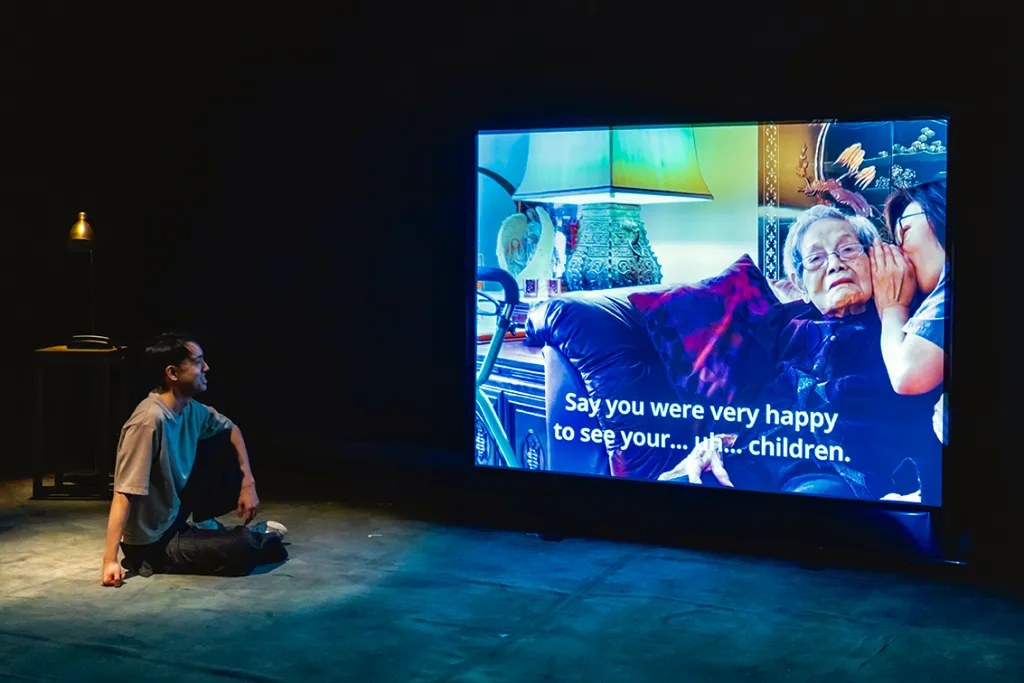
As a multimedia artist, Kevin Matthew Wong makes good use of the black box theatre’s intimacy and flexibility. His incorporation of projection, video, and recorded soundscapes not only constructs vivid settings but also layers the show with emotional nuance. One particularly memorable moment features a home video of Wong in conversation with his centenarian grandmother. The footage is raw, tender, and unfiltered — a quiet yet powerful portrait of intergenerational distance. The two can barely hold a proper conversation, limited by differences in language, experience, and age. And yet, the bond between them is unmistakable, their affection flowing in ways that transcend words.
Visually, the show is stunning. Wong blends vivid imagery — bustling Chinatowns, ancient temples, and dreamlike memories — into an immersive environment. These visual elements not only captivate but also serve a deeper narrative purpose, pushing the story forward with precision and intent. Yet, while the multimedia components are expertly crafted, it is Kevin Matthew Wong himself who truly anchors the production. His dynamic presence and commanding performance bring the story to life, grounding the entire experience in a deeply personal and relatable way.
Performing solo for 90 uninterrupted minutes, Wong delivers a tour de force performance that is equal parts intimate and theatrical. His versatility is remarkable — he shifts seamlessly between characters, from respectful to nosy uncles, to hoveringly supportive aunties. His mimicry is so precise and grounded that the stage feels momentarily populated by an entire community. He sings, dances, jokes, and emotes with authenticity. Each character is lovingly crafted, yet his own voice as narrator always shines through.
What’s most remarkable is Wong’s ability to balance humour with vulnerability. He brings a comedian’s touch to the stage and life, using sincere, almost childlike curiosity to navigate and narrate moments of cultural confusion and absurdity. He pokes fun at the cultural clashes he encounters, but just as readily laughs at his own naiveté. The result is a thoughtfully crafted performance, offering light-hearted entertainment while subtly prompting deeper reflection, ensuring the audience leaves both amused and enlightened.
Benevolence is a moving meditation on what it means to belong , to a family, a community and a culture. It’s about the struggle to preserve something intangible, and the powerful resilience found in acts of care, memory, and kindness. In a world where language can fail, where time may erode tradition, Wong shows that connection, however imperfect, still endures.
Just like Zhuangzi’s classic tale of the Butterfly Dream, Benevolence captures the fluid nature of identity, blurring the lines between memory and imagination, heritage and individuality. Through evolution, we are not bound by either the past or the present but are freed to live more authentically and expansively in both.